AkkaOfEmpires: Extending the GUI and actor factory

akkadotnet-logoIn my last AkkaOfEmpires blog entry I started a Graphic User Interface (GUI), only on console mode, to display how the actors in my system behave. In this project I use the Akka.NET framework (implementation of the actor model)  to re-create some of the rules present in Age of Empires II.

I was able to add a “console” implementation for two actors on the three I currently have in the system. This last actor is harder to “override” because its creation is done by another actor. Here is the code I am talking about (inside the VillagerActor):

var props = Props.Create<ResourceHarvesterActor>(Context.System.Scheduler, Self);
var resourceHarvesterRoutine = Context.ActorOf(props);

An I would like to use the following implementation of the ResourceHarvesterActor.

public class ConsoleResourceHarvesterActor : ResourceHarvesterActor
{
    public ConsoleResourceHarvesterActor(ITellScheduler messageScheduler, IActorRef villagerAcor)
        : base(messageScheduler, villagerAcor)
    {
    }
 
    public override void Handle(ResourceHarvested message)
    {
        base.Handle(message);
        Console.WriteLine("1 unit of {0} harvested. (carrying {1}).", ResourceToHarvest, CurrentlyCarrying);
    }
}

But, as I said in my last article, I cannot directly use this class in the VillagerActor, because it would create a circular reference and I don’t want to have “GUI” classes in my “core” project.

I think this issue shows that there is some coupling in the VillagerActor, indeed the class directly use the Props API and the Context. I believe it would be a good thing to extract this part of the code and encapsulate it in a dependency.

An actor factory

To fix this issue I will create a factory which will deal with the creation of the subroutine for the other actors and I will be able to use this class as a dependency for the VillagerActor. This way I will remove some coupling in the code.

Here is the factory:

public class SubroutinesFactory
{
    public virtual IActorRef CreateResourceHarvesterActor(IActorContext actorContext, IActorRef villagerActor)
    {
        var props = Props.Create<ResourceHarvesterActor>(actorContext.System.Scheduler, villagerActor);
        var resourceHarvesterRoutine = actorContext.ActorOf(props);
        return resourceHarvesterRoutine;
    }
}

The method in this factory needs some parameters to do its job, first an actor context in order to access the Scheduler and to create the IActorRef instance, secondly the IActorRef for the VillagerActor needing the subroutine.

I can now update my code to use this new class.

public class VillagerActor : ReceiveActor
{
    private readonly IActorRef _resourcesSupervisor;
    private readonly SubroutinesFactory _subroutinesFactory;
 
    public VillagerActor(IActorRef resourcesSupervisor, SubroutinesFactory subroutinesFactory)
    {
        _resourcesSupervisor = resourcesSupervisor;
        _subroutinesFactory = subroutinesFactory;
        //...
    }
 
    //...
 
    protected virtual void ResourceHarvester(IHarvestResourceCommand command)
    {
        //...
 
        var resourceHarvesterRoutine = _subroutinesFactory.CreateResourceHarvesterActor(Context, Self);
        resourceHarvesterRoutine.Tell(command);
 
        //...
    }
 
    //...
}

Override in the GUI

Now, the good thing is that I can create another implementation for this factory in my Console GUI project to use the ConsoleResourceHarvesterActor instead of the regular ResourceHarvesterActor.

public class ConsoleSubroutinesFactory : SubroutinesFactory
{
    public override IActorRef CreateResourceHarvesterActor(IActorContext actorContext, IActorRef villagerActor)
    {
        var props = Props.Create<ConsoleResourceHarvesterActor>(actorContext.System.Scheduler, villagerActor);
        var consoleActor = actorContext.ActorOf(props);
        return consoleActor;
    }
}

And now I can update my program in the GUI project to inject the implementation I want.

static void Main(string[] args)
{
    var system = AkkaOfEmpiresSystem.Start();
 
    var supervisorProps = Props.Create<ConsoleResourcesSupervisorActor>();
    var supervisor = system.ActorOf(supervisorProps);
 
    var consoleSubroutinesFactory = new ConsoleSubroutinesFactory();
    var villagerProps = Props.Create<ConsoleVillagerActor>(supervisor, consoleSubroutinesFactory);
    var gathered = system.ActorOf(villagerProps);
    gathered.Tell(new GatherFruits());
 
    system.AwaitTermination();
}

(To avoid too much flooding on the console I put only one villager instead of three).

And when launching the application, we can see the following output, letting us know what is happening.
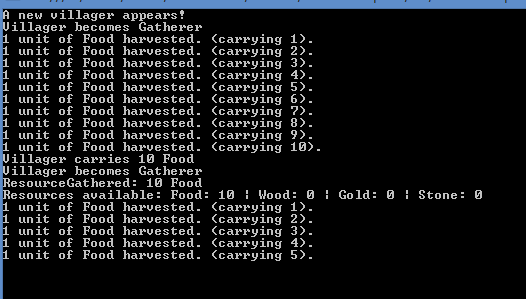
AkkaOfEmpires-Second

We now have what we wanted, information is displayed for each actor and we have a pretty good idea of what is going on. The overall behavior looks good.

In this post I showed a way to extract the logic of creating an actor in a dependency in order to override the behavior, you can find the entire solution here.

For the moment my project is quite small and I only have two levels in my class hierarchy, therefore this “factory” fix will be hard to continue in the future because I have to inject the dependencies at the “boundaries” (the Main() method in my case). In the next AkkaOfEmpires post I will introduce Dependency Injection (DI) when working with Akka.NET to remove this future problem.

See you next time!

AkkaOfEmpires: Refactoring and First GUI

akkadotnet-logoToday, I will continue my journey with my project named AkkaOfEmpires. In this project I implement some of the rules of the game Age Of Empires II using the actor model with Akka.NET. You can find the last entries about the project here and here.

In this blog post I will not add new functionalities related to the game, first I feel the need to change a few things I made. I want to change the communication between the VillagerActor and the ResourceHarvesterActor routine. See the code for these two classes below.

Here is the VillagerActor:

public class VillagerActor : ReceiveActor
{
    private readonly IActorRef _resourcesSupervisor;
 
    public VillagerActor(IActorRef resourcesSupervisor)
    {
        _resourcesSupervisor = resourcesSupervisor;
        Profession = Profession.Idle;
 
        var props = Props.Create<ResourceHarvesterActor>(Context.System.Scheduler, _resourcesSupervisor);
        _resourceHarvesterRoutine = Context.ActorOf(props);
    }
 
    public Profession Profession { get; private set; }
    public Resource ResourceToRecolt { get; private set; }
 
    private readonly IActorRef _resourceHarvesterRoutine;
 
    protected override void PreStart()
    {
        base.PreStart();
        Become(Idle);
    }
 
    private void Idle()
    {
        ListenForCommands();
    }
 
    private void ResourceHarvester(IHarvestResourceCommand command)
    {
        Profession = command.AssociatedProfession;
        ResourceToRecolt = command.ResourceToRecolt;
 
        _resourceHarvesterRoutine.Tell(command);
 
        ListenForCommands();
    }
 
    private void ListenForCommands()
    {
        Receive<IHarvestResourceCommand>(m => Become(() => ResourceHarvester(m)));
    }
}

And theResourceHarvesterActor:

public class ResourceHarvesterActor : TypedActor,
    IHandle<IHarvestResourceCommand>,
    IHandle<ResourceHarvesterActor.ResourceHarvested>
{
    private readonly ITellScheduler _messageScheduler;
    private readonly IActorRef _resourcesSupervisor;
 
    public const uint MAX_CAPACITY = 10;
    public uint CurrentlyCarrying { get; private set; }
 
    public Resource ResourceToHarvest { get; private set; }
 
    public ResourceHarvesterActor(ITellScheduler messageScheduler, IActorRef resourcesSupervisor)
    {
        _messageScheduler = messageScheduler;
        _resourcesSupervisor = resourcesSupervisor;
        CurrentlyCarrying = 0;
    }
 
    public void Handle(IHarvestResourceCommand message)
    {
        if (message.ResourceToRecolt != ResourceToHarvest)
        {
            ResourceToHarvest = message.ResourceToRecolt;
            CurrentlyCarrying = 0;
        }
        _messageScheduler.ScheduleTellOnce(TimeSpan.FromSeconds(1), Self, new ResourceHarvested(), Self);
    }
 
    public void Handle(ResourceHarvested message)
    {
        CurrentlyCarrying++;
        if (CurrentlyCarrying == MAX_CAPACITY)
            _resourcesSupervisor.Tell(new ResourceGathered(ResourceToHarvest, CurrentlyCarrying));
        else
            _messageScheduler.ScheduleTellOnce(TimeSpan.FromSeconds(1), Self, new ResourceHarvested(), Self);
    }
 
    public class ResourceHarvested { }
}

Refactoring

What I don’t like with this code is the fact that the “routine” sends the message to the resources supervisor directly. In my opinion the routine should notify the VillagerActor when the capacity is reached and then stops its process.

For me this child actor should not be aware of any actor except itself and its parent. The higher level actor will take care of the communication with the supervisor.

Akka.NET does not provide any shortcut to send messages to the parent of an actor, therefore we will have to inject the reference. We already have a parameter in the constructor of type IActorRef, for the supervisor, from now it will be a reference to the VillagerActor. The type does not change but the actor at the other side of this reference will, then it is extremely important to use proper names when manipulating IActorRef references.

private readonly IActorRef _villagerActor;
 
public ResourceHarvesterActor(ITellScheduler messageScheduler, IActorRef villagerAcor)
{
    _messageScheduler = messageScheduler;
    _villagerActor = villagerAcor;
    CurrentlyCarrying = 0;
}

I now need to refactor the case when the maximum capacity is reached. The villagerActor will be notify and will behave accordingly and the routine will be stopped.

public virtual void Handle(ResourceHarvested message)
{
    CurrentlyCarrying++;
    if (CurrentlyCarrying == MAX_CAPACITY)
    {
        _villagerActor.Tell(new MaxCapacityReached(CurrentlyCarrying));
        Context.Stop(Self);
    }
    else
        _messageScheduler.ScheduleTellOnce(TimeSpan.FromSeconds(1), Self, new ResourceHarvested(), Self);
}

To do this, I created a new message type names MaxCapacityReached with the amount of resource gathered. And to stop the actor I use the Stop() method of the Context property with Self as argument. By doing so the actor system will stop the current instance of the actor.

Now I need to update the behavior of the VillagerActor to properly use the ResourceGathererActor.

protected virtual void ResourceHarvester(IHarvestResourceCommand command)
{
    _currentCommand = command;
    Profession = command.AssociatedProfession;
    ResourceToRecolt = command.ResourceToRecolt;
 
    var props = Props.Create<ResourceHarvesterActor>(Context.System.Scheduler, Self);
    var resourceHarvesterRoutine = Context.ActorOf(props);
    resourceHarvesterRoutine.Tell(command);
 
    ListenForCommands();
}

I moved the creation of the child actor (the usage of Props and Context) inside the method (it was in the constructor before), because now the routine actor will stop once its job is done. If this is not done, the program will not crash, instead the message will not be delivered and will become a “dead letter” (more information on JVM Akka website here). Note that I also save the received command in a field, which will be used shortly.

Now this VillagerActor also need a new handler for MaxCapacityReached message in order to “return to a depot” to increase the amount of resources available.

protected virtual void ResourceCarrier(uint quantity)
{
    _resourcesSupervisor.Tell(new ResourceGathered(ResourceToRecolt, quantity));
    Self.Tell();
    ListenForCommands();
}
 
private void ListenForCommands()
{
    Receive<IHarvestResourceCommand>(m => Become(() => ResourceHarvester(m)));
    Receive<MaxCapacityReached>(m => Become(() => ResourceCarrier(m.Quantity)));
}

Once the message has been sent to the ResourceSupervisorActor the VillagerActor will send itself the command it previously stored, this way it will continue its job by creating a new child actor (a routine) to gather resources.

Now the question is: Does that really work as expected? I could try to make some tests to cover these cases but I fear that they will be extremely difficult to write. Instead I think it is time for me to create the first GUI for the project. Do not get too excited, I will simply be a Console GUI…

The Console GUI

280px-Age_of_Empires_2_The_Age_of_Kings_LogoTo display the behaviors of the actors, I could simply add some Console.WriteLine() in the methods but I don’t want to pollute the code of my actors with this. Instead I will use inheritance to add this behavior.

To be able to do this, I have to change a few private methods and make them protected virtual (see in the code samples above). And I can now define some ConsoleActors in a new project (AkkaOfEmpires.ConsoleUI).

ConsoleResourcesSupervisorActor:

public class ConsoleResourcesSupervisorActor : ResourcesSupervisorActor
{
    public override void Handle(ResourceGathered message)
    {
        Console.WriteLine("ResourceGathered: {0} {1}", message.Quantity, message.ResourceType);
        base.Handle(message);
        Console.WriteLine("Resources available: {0}: {1} | {2}: {3} | {4}: {5} | {6}: {7}",
            Resource.Food, ResourcesAmounts[Resource.Food],
            Resource.Wood, ResourcesAmounts[Resource.Wood],
            Resource.Gold, ResourcesAmounts[Resource.Gold],
            Resource.Stone, ResourcesAmounts[Resource.Stone]);
    }
}

ConsoleVillagerActor:

public class ConsoleVillagerActor : VillagerActor
{
    public ConsoleVillagerActor(IActorRef resourcesSupervisor)
        : base(resourcesSupervisor)
    {
    }
 
    protected override void PreStart()
    {
        Console.WriteLine("A new villager appears!");
        base.PreStart();
    }
 
    protected override void ResourceHarvester(IHarvestResourceCommand command)
    {
        Console.WriteLine("Villager becomes {0}", command.AssociatedProfession);
        base.ResourceHarvester(command);
    }
 
    protected override void ResourceCarrier(uint quantity)
    {
        Console.WriteLine("Villager carries {0} {1}", quantity, ResourceToRecolt);
        base.ResourceCarrier(quantity);
    }
}

This way I am able to separate the “UI logic” from the message handling of the actors.

I have also created a static method creating the actor system (in the AkkaOfEmpires project this time):

public static class AkkaOfEmpiresSystem
{
    public static ActorSystem Start()
    {
        var system = ActorSystem.Create("AkkaOfEmpires");
 
        return system;
    }
}

And here is the Main program of the console application:

static void Main(string[] args)
{
    var system = AkkaOfEmpiresSystem.Start();
 
    var supervisorProps = Props.Create<ConsoleResourcesSupervisorActor>();
    var supervisor = system.ActorOf(supervisorProps);
 
    var villagerProps = Props.Create<ConsoleVillagerActor>(supervisor);
    var gathered = system.ActorOf(villagerProps);
    gathered.Tell(new GatherFruits());
 
    var shepherd = system.ActorOf(villagerProps);
    shepherd.Tell(new ShepherdFlock());
 
    var lumberjack = system.ActorOf(villagerProps);
    lumberjack.Tell(new CutTrees());
 
    system.AwaitTermination();
}

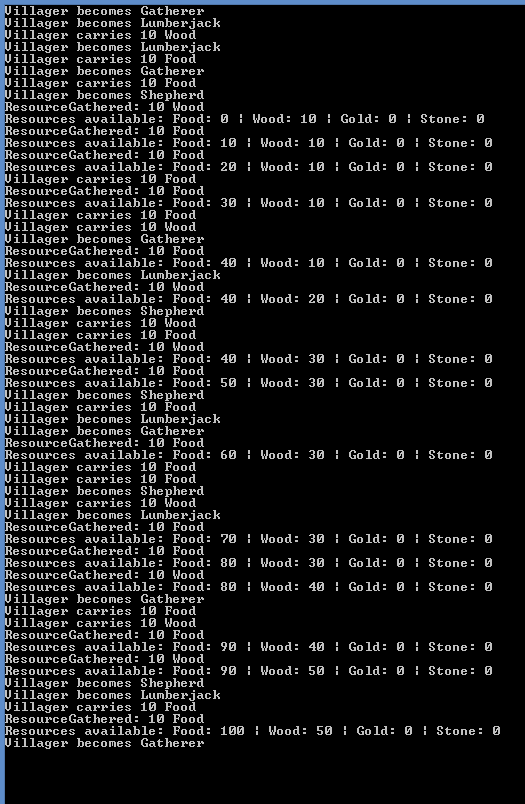
This program will create the resources supervisor actor and 3 villagers, the first will become a gatherer, the second a shepherd and the last a lumberjack. Now if we launched this program we have the following ouput (after about 50 seconds).

AkkaOfEmpires-First

Looks good, the food and wood amounts increase over time, these villagers are now efficient workers!

But… What about a ConsoleResourceHarvesterActor? Well, this one is a bit different, its creation is directly inside the VillagerActor and not in the program. I cannot used this specific actor in the code of the VillagerActor (Circular reference between AkkaOfEmpires and AkkaOfEmpires.ConsoleUI) and I do not want to, a UI class has nothing to do in my core project.

The resolution of this “issue” will be in my next AkkaOfEmpires blog post. Meanwhile you can take a look at the entire solution on GitHub.

See you next time!

Easy mocking with NSubstitute

NSubstitute logo
NSubstitute logo

Several months ago I introduced the concept of mocking dependencies of a class in order to ease the writing of tests for it. I also introduced the Moq library which is a mocking library and today I will introduced another one: NSubstitute. This project is open source and you can find it on GitHub.

I will not cover all the functionalities it offers, instead I will show you how it works with an example like I did with Moq. First you can install NSubstitute with Nuget:

Install-Package NSubstitute

What to test?

I have created the following service with a bit of logic to test.

public class NotificationService
{
    public NotificationService(IUserRepository userRepository, INotifier notifier, ILogger logger)
    {
        _userRepository = userRepository;
        _notifier = notifier;
        _logger = logger;
    }
 
    private readonly IUserRepository _userRepository;
    private readonly INotifier _notifier;
    private readonly ILogger _logger;
 
    public void NotifyUser(int userId)
    {
        User user;
        try
        {
            user = _userRepository.GetById(userId);
        }
        catch (Exception ex)
        {
            _logger.Error(ex.Message);
            return;
        }
        if (user.HasActivatedNotification)
        {
            _notifier.Notify(user);
        }
    }
}

This service relies on dependency injection to do its work, you’ll find these dependencies below.

public interface INotifier
{
    void Notify(User user);
}
 
public interface IUserRepository
{
    User GetById(int userId);
}
 
public interface ILogger
{
    void Error(string message);
}
 
public class User
{
    public bool HasActivatedNotification { get; set; }
}
 
public class InvalidUserIdException : Exception
{
    public override string Message
    {
        get { return "Given user ID is invalid"; }
    }
}

Let’s test it!

I will now write tests to cover the logic hold by the NotificationService class using NSubstitute. I will also use xUnit as testing framework, you can find more information about this project here.

In order to test the service we will have to instantiate it, and therefore we will have to inject the dependencies. So the first question is: how to create mock (or substitute) with NSubstitute? As a reminder it is done like this with Moq:

Mock<IUserRepository> mockRepository = new Mock<IUserRepository>();
IUserRepository repo = mockRepository.Object;

With NSubstitute the concept is similar but with one noticeable change.

IUserRepository userRepository = Substitute.For<IUserRepository>();

There is no wrapper for the mock, we directly manipulate an instance of the interface we want to substitute. You might wonder how to use it as a mock if it has only the methods defined in the interface, I’ll come to that later.

We can now setup our test class for the service with all the dependencies.

public class NotificationService_Should
{
    private readonly NotificationService _service;
 
    private readonly IUserRepository _userRepository;
    private readonly INotifier _notifier;
    private readonly ILogger _logger;
 
    public NotificationService_Should()
    {
        _userRepository = Substitute.For<IUserRepository>();
        _notifier = Substitute.For<INotifier>();
        _logger = Substitute.For<ILogger>();
 
        _service = new NotificationService();
    }
}

For information, the test setup is done in the class constructor with xUnit.

We can now focus on writing the first test for the class: verifying that the repository is called when executing the NotifyUser method. To do so we will use some extension methods provided by NSubstitute (here is the answer to the previous question).

[Fact(DisplayName = "NotifyUser calls the repository")]
public void Call_Repository()
{
    _service.NotifyUser(Arg.Any<int>());
    _userRepository.Received().GetById(Arg.Any<int>());
}

The Received() extension method checks that the following method is called. Since we don’t have to test for a particular user ID, we can use the Arg.Any<T>() method to specify that any integer is valid (with Moq it is It.IsAny<T>()). We run the test and…

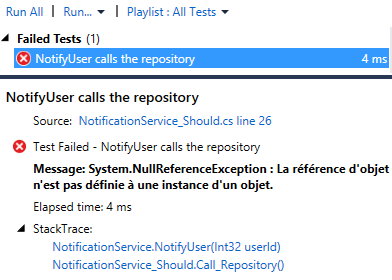
Red-Test-Null

…it’s red? NullReferenceException… Of course! The mock repository does not return any instance of User and the execution fails after when trying to use the reference. Let’s fix this by configuring the substitute.

[Fact(DisplayName = "NotifyUser calls the repository")]
public void Call_Repository()
{
    _userRepository.GetById(Arg.Any<int>()).Returns(new User());
    _service.NotifyUser(1);
    _userRepository.Received().GetById(Arg.Any<int>());
}

Now the test is green, but in this test we setup a mock and then we test that it has been called, in my opinion it is not very constructive. We should try to focus on testing something else, the rest of the method’s logic depends on a property of the User, let’s test this for instance.

public NotificationService_Should()
{
    _userRepository = Substitute.For<IUserRepository>();
    _notifier = Substitute.For<INotifier>();
    _logger = Substitute.For<ILogger>();
 
    _service = new NotificationService(_userRepository, _notifier, _logger);
 
    _userRepository
        .GetById(Arg.Is<int>(i => i < 10))
        .Returns(new User { HasActivatedNotification = true });
    _userRepository
        .GetById(Arg.Is<int>(i => i >= 10))
        .Returns(new User { HasActivatedNotification = false });
}
 
[Fact(DisplayName = "NotifyUser calls notifier if user has activated the notifications")]
public void Call_Notifier_When_User_Has_Activated_Notification()
{
    _service.NotifyUser(1);
    _notifier.Received().Notify(Arg.Any<User>());
}
 
[Fact(DisplayName = "NotifyUser does not call notifier if user has not activated the notifications")]
public void Does_Not_Call_Notifier_When_User_Has_Not_Activated_Notification()
{
    _service.NotifyUser(11);
    _notifier.DidNotReceive().Notify(Arg.Any<User>());
}

This time I used the Arg.Is<T>() method to add condition to the substitute, this way I can setup the result of a method depending on some conditions. Here I set the HasActivatedNotification property to true if the userId is inferior to 10 and to false otherwise.

And to test that a method is not called I use the DidNotReceive() extension method. Now I will write a test for the case when an exception is thrown by the repository to check that the logger is correctly called.

public NotificationService_Should()
{
    _userRepository = Substitute.For<IUserRepository>();
    _notifier = Substitute.For<INotifier>();
    _logger = Substitute.For<ILogger>();
 
    _service = new NotificationService(_userRepository, _notifier, _logger);
 
    _userRepository
        .GetById(Arg.Is<int>(i => i < 10))
        .Returns(new User { HasActivatedNotification = true });
    _userRepository
        .GetById(Arg.Is<int>(i => i >= 10))
        .Returns(new User { HasActivatedNotification = false });
    _userRepository
        .GetById(Arg.Is<int>(i => i < 0))
        .Returns(user => { throw new InvalidUserIdException(); });
}
 
[Fact(DisplayName = "NotifyUser calls logger when an exception is thrown")]
public void Call_Logger_When_An_Exception_Is_Thrown()
{
    _service.NotifyUser(-1);
    _logger.Received().Error("Given user ID is invalid");
}

The service is now covered with tests thanks to the use of NSubstitute.

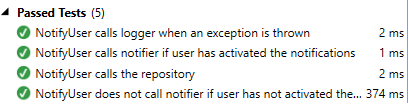
Green-Tests

This library offers more functionalities, you can find them on the documentation page of the project website.

As for me, I only discovered this library recently, I am more used to Moq. But I must say that I like the API offered by NSubstitute, I find it more “fluent”. I think it can be really helpful when doing Test Driven Development (TDD). I will definitely give it a shot for future projects.

Choosing a mocking library is important in order to write tests easily when using dependency injection and there is a lot of choice for this, Moq and NSubstitute are some of them. And you? What is your favorite library for mocking? What does it offer that others don’t have?

See you next time!

Akka.NET: Delegating work to child actors

akkadotnet-logoToday I will continue to present my work on AkkaOfEmpires, in this project I implement some of the rules from the game Age Of Empires II using the actor model with Akka.NET. You can have a look at the first step here.

In this last entry I introduced the concept of behavior switching using Akka.NET while providing an implementation for a villager (unit in the game) gathering various types of resources. In this article I will continue to work on the VillagerActor and I will mostly do refactoring.

280px-Age_of_Empires_2_The_Age_of_Kings_LogoFor the moment the villager has a dedicated method for all the professions he can have when gathering resource, see the class below.

public class VillagerActor : ReceiveActor
{
    private readonly IActorRef _resourcesSupervisor;
 
    public VillagerActor(IActorRef resourcesSupervisor)
    {
        _resourcesSupervisor = resourcesSupervisor;
        Profession = Profession.Idle;
    }
 
    public Profession Profession { get; private set; }
    public Resource ResourceToRecolt { get; private set; }
 
    protected override void PreStart()
    {
        base.PreStart();
        Become(Idle);
    }
 
    private void Idle()
    {
        CommandsHandler();
    }
 
    private void Gatherer()
    {
        Profession = Profession.Gatherer;
        ResourceToRecolt = Resource.Food;
        // repeat until new order or lack of bushes
        _resourcesSupervisor.Tell(new ResourceRecolted { ResourceType = ResourceToRecolt, Quantity = 10 });
 
        CommandsHandler();
    }
 
    private void Shepherd()
    {
        Profession = Profession.Shepherd;
        ResourceToRecolt = Resource.Food;
        // repeat until new order or lack of sheeps
        _resourcesSupervisor.Tell(new ResourceRecolted { ResourceType = ResourceToRecolt, Quantity = 10 });
 
        CommandsHandler();
    }
 
    private void Hunter()
    {
        Profession = Profession.Hunter;
        ResourceToRecolt = Resource.Food;
 
        _resourcesSupervisor.Tell(new ResourceRecolted{ResourceType = ResourceToRecolt, Quantity = 10});
 
        CommandsHandler();
    }
 
    private void Farmer()
    {
        Profession = Profession.Farmer;
        ResourceToRecolt = Resource.Food;
 
        _resourcesSupervisor.Tell(new ResourceRecolted { ResourceType = ResourceToRecolt, Quantity = 10 });
 
        CommandsHandler();
    }
 
    private void Fisherman()
    {
        Profession = Profession.Fisherman;
        ResourceToRecolt = Resource.Food;
 
        _resourcesSupervisor.Tell(new ResourceRecolted { ResourceType = ResourceToRecolt, Quantity = 10 });
 
        CommandsHandler();
    }
 
    private void Lumberjack()
    {
        Profession = Profession.Lumberjack;
        ResourceToRecolt = Resource.Wood;
 
        _resourcesSupervisor.Tell(new ResourceRecolted {ResourceType = ResourceToRecolt, Quantity = 10});
        CommandsHandler();
    }
 
    private void StoneMiner()
    {
        Profession = Profession.StoneMiner;
        ResourceToRecolt = Resource.Stone;
 
        _resourcesSupervisor.Tell(new ResourceRecolted { ResourceType = ResourceToRecolt, Quantity = 10 });
        CommandsHandler();
    }
 
    private void GoldMiner()
    {
        Profession = Profession.GoldMiner;
        ResourceToRecolt = Resource.Gold;
 
        _resourcesSupervisor.Tell(new ResourceRecolted { ResourceType = ResourceToRecolt, Quantity = 10 });
        CommandsHandler();
    }
 
    private void CommandsHandler()
    {
        Receive<GatherFruits>(m => Become(Gatherer));
        Receive<ShepherdFlock>(m => Become(Shepherd));
        Receive<HuntPrey>(m => Become(Hunter));
        Receive<FarmCrops>(m => Become(Farmer));
        Receive<CatchFish>(m => Become(Fisherman));
        Receive<CutTrees>(m => Become(Lumberjack));
        Receive<MineStone>(m => Become(StoneMiner));
        Receive<MineGold>(m => Become(GoldMiner));
    }
}

As you can see the code is quite redundant and there is already a lot of methods for the class. Yet a villager can do a lot more than simply gathering resource and I fear that my class will become too big. When working with Object Oriented Programming (OOP) I try to follow the SOLID principles and I feel like I’m starting to break the Single Responsibility Principle.

My goal is to create a child actor for the VillagerActor to deal with all the resource gathering to avoid having too much logic inside this class. But first I will do some refactoring.

Refactoring phase

You may have noticed that all the commands related to the resource gathering are similar, they are associated to a type of resource and to a profession, it looks like a good opportunity to introduce an interface for all of these commands.

public interface IHarvestResourceCommand
{
    Resource ResourceToRecolt { get; }
    Profession AssociatedProfession { get; }
}
 
public abstract class HarvestFood : IHarvestResourceCommand
{
    public Resource ResourceToRecolt
    {
        get { return Resource.Food; }
    }
 
    public abstract Profession AssociatedProfession { get; }
}
 
public abstract class HarvestWood : IHarvestResourceCommand
{
    public Resource ResourceToRecolt
    {
        get { return Resource.Wood; }
    }
 
    public abstract Profession AssociatedProfession { get; }
}
 
public abstract class HarvestGold : IHarvestResourceCommand
{
    public Resource ResourceToRecolt
    {
        get { return Resource.Gold; }
    }
 
    public abstract Profession AssociatedProfession { get; }
}
 
public abstract class HarvestStone : IHarvestResourceCommand
{
    public Resource ResourceToRecolt
    {
        get { return Resource.Stone; }
    }
 
    public abstract Profession AssociatedProfession { get; }
}

And now each command can inherit from the correct abstract class and just have to provide the profession associated to it (see some examples below).

public class FarmCrops : HarvestFood
{
    public override Profession AssociatedProfession
    {
        get { return Profession.Farmer; }
    }
}
 
public class CatchFish : HarvestFood
{
    public override Profession AssociatedProfession
    {
        get { return Profession.Fisherman; }
    }
}
 
public class CutTrees : HarvestWood
{
    public override Profession AssociatedProfession
    {
        get { return Profession.Lumberjack; }
    }
}
 
public class MineStone : HarvestStone
{
    public override Profession AssociatedProfession
    {
        get { return Profession.Miner; }
    }
}
 
public class MineGold : HarvestGold
{
    public override Profession AssociatedProfession
    {
        get { return Profession.Miner; }
    }
}

I can now update the implementation of the VillagerActor to use the properties available in the classes I just refactored to simplify it and to remove all the code duplication.

private void ResourceHarvester(IHarvestResourceCommand command)
{
    Profession = command.AssociatedProfession;
    ResourceToRecolt = command.ResourceToRecolt;
 
    _resourcesSupervisor.Tell(new ResourceRecolted { ResourceType = ResourceToRecolt, Quantity = 10 });
 
    ListenForCommands();
}
 
private void ListenForCommands()    // previously CommandsHandler()
{
    Receive<IHarvestResourceCommand>(m => Become(() => ResourceHarvester(m)));
}

In my opinion this is way cleaner than before even if the notion of one method by profession has been removed, we still have a property for this.

Now I think that I have a good base to add the child actor which will have a bit more logic than this current implementation.

The child actor

In Age Of Empires II, gathering resource takes time, a villager harvests resource one by one and brings them back to the a resource depot when his capacity is full. I will implement this logic in the new child actor called ResourceHarvesterActor. This actor is not a unit on its own, it will represent a subroutine of the villager.

public class ResourceHarvesterActor : TypedActor,
    IHandle<IHarvestResourceCommand>,
    IHandle<ResourceHarvesterActor.ResourceHarvested>
{
    private readonly ITellScheduler _messageScheduler;
    private readonly IActorRef _resourcesSupervisor;
 
    public const uint MAX_CAPACITY = 10;
    public uint CurrentlyCarrying { get; private set; }
 
    public Resource ResourceToHarvest { get; private set; }
 
    public ResourceHarvesterActor(ITellScheduler messageScheduler, IActorRef resourcesSupervisor)
    {
        _messageScheduler = messageScheduler;
        _resourcesSupervisor = resourcesSupervisor;
        CurrentlyCarrying = 0;
    }
 
    public void Handle(IHarvestResourceCommand message)
    {
        if (message.ResourceToRecolt != ResourceToHarvest)
        {
            ResourceToHarvest = message.ResourceToRecolt;
            CurrentlyCarrying = 0;
        }
        _messageScheduler.ScheduleTellOnce(TimeSpan.FromSeconds(1), Self, new ResourceHarvested(), Self);
    }
 
    public void Handle(ResourceHarvested message)
    {
        CurrentlyCarrying++;
        if (CurrentlyCarrying == MAX_CAPACITY)
            _resourcesSupervisor.Tell(new ResourceGathered { Quantity = CurrentlyCarrying, ResourceType = ResourceToHarvest });
        else
            _messageScheduler.ScheduleTellOnce(TimeSpan.FromSeconds(1), Self, new ResourceHarvested(), Self);
    }
 
    public class ResourceHarvested { }
}

To simulate the game logic, this actor will send a message to itself every second to increment the amount of resource the villager is carrying. To do so I use the ITellScheduler interface which is available in Akka.NET. This allows to set a delay before sending a message to an actor, in this case the actor is itself so I use the Self property. I chose to use this interface instead of an implementation to be able to inject the dependency to ease the testability of the class.

I also added a condition to detect when the villager is at full capacity, when it occurs then the ResourceSupervisorActor is used to increment the global counter for the resource being harvested (in the game the villager goes to the depot for this).

There is another game rule I implemented in this actor, the fact that a villager cannot gather several types a resource at the same time. For example if a lumberjack is ordered to go fishing, then the wood he is carrying is lost. I made a unit test to cover this case:

[Fact(DisplayName = "ResourceHarvesterActor Should Empty CurrentlyCarrying If Different Resource To Harvest")]
public void Empty_CurrentlyCarrying_If_Different_Resource_To_Harvest()
{
    _harvester.Tell(VillagerOrders.CutTrees);
    _harvester.Tell(new ResourceHarvesterActor.ResourceHarvested());
    _harvester.UnderlyingActor.CurrentlyCarrying.ShouldBe<uint>(1);
    _harvester.Tell(VillagerOrders.CatchFish);
    _harvester.UnderlyingActor.CurrentlyCarrying.ShouldBe<uint>(0);
}

Now I will use this new actor inside the VillagerActor.

public class VillagerActor : ReceiveActor
{
    private readonly IActorRef _resourcesSupervisor;
 
    public VillagerActor(IActorRef resourcesSupervisor)
    {
        _resourcesSupervisor = resourcesSupervisor;
        Profession = Profession.Idle;
 
        var props = Props.Create<ResourceHarvesterActor>(Context.System.Scheduler, _resourcesSupervisor);
        _resourceHarvesterRoutine = Context.ActorOf(props);
    }
 
    public Profession Profession { get; private set; }
    public Resource ResourceToRecolt { get; private set; }
 
    private readonly IActorRef _resourceHarvesterRoutine;
 
    protected override void PreStart()
    {
        base.PreStart();
        Become(Idle);
    }
 
    private void Idle()
    {
        ListenForCommands();
    }
 
    private void ResourceHarvester(IHarvestResourceCommand command)
    {
        Profession = command.AssociatedProfession;
        ResourceToRecolt = command.ResourceToRecolt;
 
        _resourceHarvesterRoutine.Tell(command);
 
        ListenForCommands();
    }
 
    private void ListenForCommands()
    {
        Receive<IHarvestResourceCommand>(m => Become(() => ResourceHarvester(m)));
    }
}

There is nothing particular in here except the fact that I used the Scheduler from the System (available through the Context) for the child actor. With the refactoring and the adding of a child actor, the VillagerActor has more the role of a coordinator than an actor since I remove all the logic from it. But this is a temporary situation, since I still have a lot of rules to implement, with time it will become a high level actor delegating work to child actors.

The code for the entire solution is available on my GitHub repository, it will allow you to see the entire project. Since I write the blog posts in parallel of the development of the solution itself it is likely that the code will change a lot with time due to constant refactoring. So it is possible that the code shown in the articles is not up-to-date when you read it, therefore do not hesitate the browse the changes in the repository’s history and to have a look at the different branches.

See you next time!